Sub menu editing

Drop Down MenusCSS Drop Down MenuPure CSS Dropdown Menu
Showing posts with label cloud. Show all posts

Saturday, May 25, 2019

Cloud-Based Services Will Make Operating Systems Irrelevant


People have been incorrectly predicting the death of operating systems and unique platforms for years going to happen. All kidding aside, it’s becoming increasingly clear as we enter 2019 that cloud-based services are rendering the value of proprietary platforms much less relevant for our day-to-day use. Sure, the initial interface of a device and the means for getting access to applications and data are dependent on the unique vagaries of each tech vendor’s platform, but the real work (or real play) of what we do on our devices is becoming increasingly separated from the artificial world of operating system user interfaces. In both the commercial and consumer realms, it’s now much easier to get access to what it is we want to do, regardless of the underlying platform.


On the commercial side, the increasing power of desktop and application virtualization tools from the likes of Citrix and VMWare, as well as moves like Microsoft’s delivering Windows desktops from the cloud all demonstrate how much simpler it is to run critical business applications on virtually any device. In fact, it will be very interesting to see how open and platform agnostic Apple makes its new video streaming service. If they make it too focused on Apple OS-based device users only, they risk having a very small impact (even with their large and well-heeled installed base), particularly given the strength of the competition.


 Crossover work and consumer products like Office 365 are also shedding any meaningful ties to specific operating systems and instead are focused on delivering a consistent experience across different operating systems, screen sizes, and device types. The concept of abstraction goes well beyond the OS level. New software being developed to leverage the wide range of different AI-specific accelerators from vendors like Qualcomm, Intel, and Arm (AI cores in their case) is being written at a high-enough level to allow them to work across a very heterogeneous computing environment.


Wednesday, May 15, 2019

The workspace will evolve


The rise of A.I. and automation software means humans are moving away from repetitive tasks and are increasingly focused on tasks only humans can do: think creatively and interact with other humans. For workspaces, this means people spend less time sitting at their desks and more time in a diversity of settings.  Uber and Spotify have revolutionized access to music and mobility, by giving everyone a private driver or a personalized playlist for a specific occasion.


There’s a specific area for the copier machine and another for the coffee maker, with the boss’ office located in an area where he or she has a full view of the whole floor. This is still what you’ll frequently see in both small and big companies, however, there’s now this growing popularity of working in a flexible workspace. It’s a common sight to see desks or cubicles positioned strategically across the room to maximize space.

The most innovative companies are no longer thinking about workspace as a single location, but rather a network of spaces that employees can access based on what they are trying to achieve--brainstorm a new product, train a new sales team, impress a client, or work quietly on their own. Employees will increasingly expect the same level of choice and diversity from their workspace.

Multi-cloud will reduce costly downtime


Multi-cloud (also multi-cloud or multi cloud) is the use of multiple cloud computing and storage services in a single network architecture. This refers to the distribution of cloud assets, software, applications, and more across several cloud environments. Those moving their data-driven apps to the cloud will need to architect them in a way so they are hybrid and multi-cloud in design to ensure zero downtime and uniform performance for their global customer base.


Just as multi-data center deployments became the new normal years ago for companies that have been successful at digitally competing in their chosen market, multi-cloud deployments will begin to usurp their place. The Uptime Institute's latest report shows that, while single cloud designs can benefit enterprises, they've become the second-leading cause of application downtime, much like single data center deployments were in the past.

Data Transfer Using 256-bit AES Encryption for SSL. We choose to apply 256-bit AES Encryption for SSL in data transfer. It's an advanced encryption that can effectively protect your data from being tampered, intercepted, and cracked. Please rest assured, it's 100% safe for you to use the service of MultCloud.

Monday, May 13, 2019

Multi-Cloud Becomes the Standard in Enterprise Computing


The early days of cloud computing in the enterprise featured prediction after prediction of a winner between public cloud vs. private cloud and even of specific cloud platforms within those environments. As we enter 2019, it’s becoming abundantly clear that all those arguments were wrong headed and that, in fact, everyone won and everyone lost at the same time.


Amazon currently leads overall cloud computing, but depending on the type of workload or other requirements, Microsoft’s Azure, Google’s GCP (Google Cloud Platform), or IBM, Oracle, or SAP cloud offerings might all make sense.The real winner is the cloud computing model, regardless of where or by whom it’s being hosted. Not only has cloud computing changed expectations about performance, reliability, and security, the DevOps software development environment it inspired and the container-focused application architecture it enabled have radically reshaped how software is written, updated, and deployed.


That’s why you see companies shifting their focus away from the public infrastructure-based aspects of cloud computing and towards the flexible software environments it enables. This, in turn, is why companies have recognized that leveraging multiple cloud types and cloud vendors isn’t a weakness or disjointed strategy, but actually a strength that can be leveraged for future endeavors. With cloud platform vendors expected to work towards more interoperability (and transportability) of workloads across different platforms in 2019, it’s very clear that the multi-cloud world is here to stay.


Wednesday, May 8, 2019

Less Social Media, More Social


The social media honeymoon is over. As people question their screen addiction, the impacts are felt in all walks of life, from dinners where guests demand the phones be put away to changing trends in the beauty industry.

“In 2019, people are looking to scale back, simplify their routine and their look,” says Melissa Butler, founder and CEO of The Lip Bar, after years where trends were set by Integra influencers and elaborate makeup tutorials on YouTube. “Social media has played such a big part in pressuring us to show up in a certain way. People are looking to reconnect with who they are, go back to the basics.”


We spend too much time looking for pleasure down at our social media outlets. What we need to begin doing is looking up and seeing what is directly in front of us. We all have the need to socialize but how can we do that with one another (with passion) if we are reluctant on technology


Monday, April 29, 2019

Cloud Computing


                Cloud computing provides a simple way to access servers, storage, databases and a broad set of application services over the Internet. A Cloud services platform such as Amazon Web Services owns and maintains the network-connected hardware required for these application services, while you provision and use what you need via a web application.
   
Whether you are running applications that share photos to millions of mobile users or you’re supporting the critical operations of your business, a cloud services platform provides rapid access to flexible and low cost IT resources. With cloud computing, you don’t need to make large upfront investments in hardware and spend a lot of time on the heavy lifting of managing that hardware. Instead, you can provision exactly the right type and size of computing resources you need to power your newest bright idea or operate your IT department. 

     
        Cloud computing has three main types that are commonly referred to as Infrastructure as a Service (IaaS), Platform as a Service (PaaS), and Software as a Service (SaaS). You can access as many resources as you need, almost instantly, and only pay for what you use. Amazon Web Services (AWS) offers a broad set of global compute, storage, database, analytics, application, and deployment services that help organizations move faster, lower IT costs, and scale applications. 

Monday, April 8, 2019

Edge Computing


                Formerly a technology trend to watch, cloud computing has become mainstream, with major players Amazon Web Services (AWS) and Google Cloud dominating the market. The adoption of cloud computing is still growing, as more and more businesses migrate to a cloud solution. But it’s no longer the emerging technology. Edge is. Move over, cloud computing, and make way for the edge.


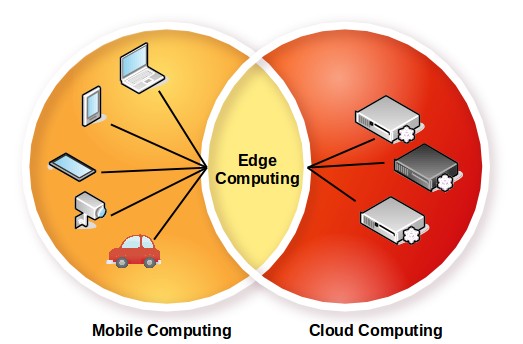
             As the quantity of data we’re dealing with continues to increase, we’ve realized the shortcomings of cloud computing in some situations. Edge computing is designed to help solve some of those problems as a way to bypass the latency caused by cloud computing and getting data to a data center for processing. It can exist “on the edge,” if you will, closer to where computing needs to happen.For this reason, edge computing can be used to process time-sensitive data in remote locations with limited or no connectivity to a centralized location.


                In those situations, edge computing can act like mini data centers. Edge computing will increase as use the Internet of Things (IoT) devices increases. By 2022, the global edge computing market is expected to reach $6.72 billion.

Categories

machine (16) human (15) medical (13) mobile (12) digital (11) business (10) city (10) internet (10) operate (10) computer (9) graphics (9) electronics (8) power (8) water (8) workplace (8) cloud (7) robots (7) space (7) webpage (7) class (6) vehicles (5) solar (4) automation (3) battery (3) car (3) data (3) television (3) camera (2) building (1) government (1) satellite (1)

Ads

Featured Post